

Relying on referrals isn't a growth strategy. It's a slow-motion hostage situation where your revenue is at the mercy of someone else's memory. You've likely accepted the "feast or famine" cycle as an inevitable tax on your independence. It's frustrating to deliver elite results for clients while your own business remains invisible to the wider market. You don't have to wait for the phone to ring. You can build a consistent pipeline for independent consultants that generates qualified conversations with high-value prospects outside your immediate network.
This article breaks down how to install a predictable acquisition system that works in the background. We'll move past the myth of word-of-mouth and show you how to leverage AI-powered research to book 5 to 10 discovery calls every month while you focus on delivery. It's time to stop being your industry's best-kept secret and start engineering your growth with clinical precision. We're moving beyond the limits of your current network to create a business development system that actually scales.
Key Takeaways
- Stop treating growth as a byproduct of good work and start viewing client acquisition as a mechanical business requirement.
- Identify the specific strategic mechanics required to build a consistent pipeline for independent consultants that operates outside your immediate network.
- Replace manual, time-consuming prospecting with AI-assisted research systems that maintain high levels of personalization and relevance.
- Implement a structured 30-Day Touchpoint Map to ensure your business development remains active even during peak client delivery periods.
- Bridge the gap between strategic positioning and booked appointments with a Done-For-You Outreach System designed for high-ticket consulting.
The Referral Trap: Why Word-of-Mouth is a Growth Ceiling
Referrals are a vanity metric for many high-level consultants. While they validate your past performance, they're a byproduct of work you've already done, not a scalable engine for your future. Relying on word-of-mouth is essentially a passive, hope-based strategy. You're waiting for the phone to ring rather than dictating who you work with and when. This creates a dangerous invisibility. If only your immediate network knows your value, you don't exist to 99% of your potential market. For consultants earning $10k to $100k monthly, this ceiling is the primary barrier to reaching the next level of scale.
The core problem is the "Feast or Famine" revenue roller coaster. When you have clients, you're often too busy to prospect. When the project ends, you realize your business development efforts have been stagnant for months. This reactive mode is the opposite of a consistent pipeline for independent consultants. A true pipeline is a mechanical system that produces qualified conversations regardless of your current delivery workload. It ensures that your market presence doesn't die the moment you sign a new contract. You shouldn't have to choose between delivering elite results and finding your next engagement.
The Math of Referral Dependency
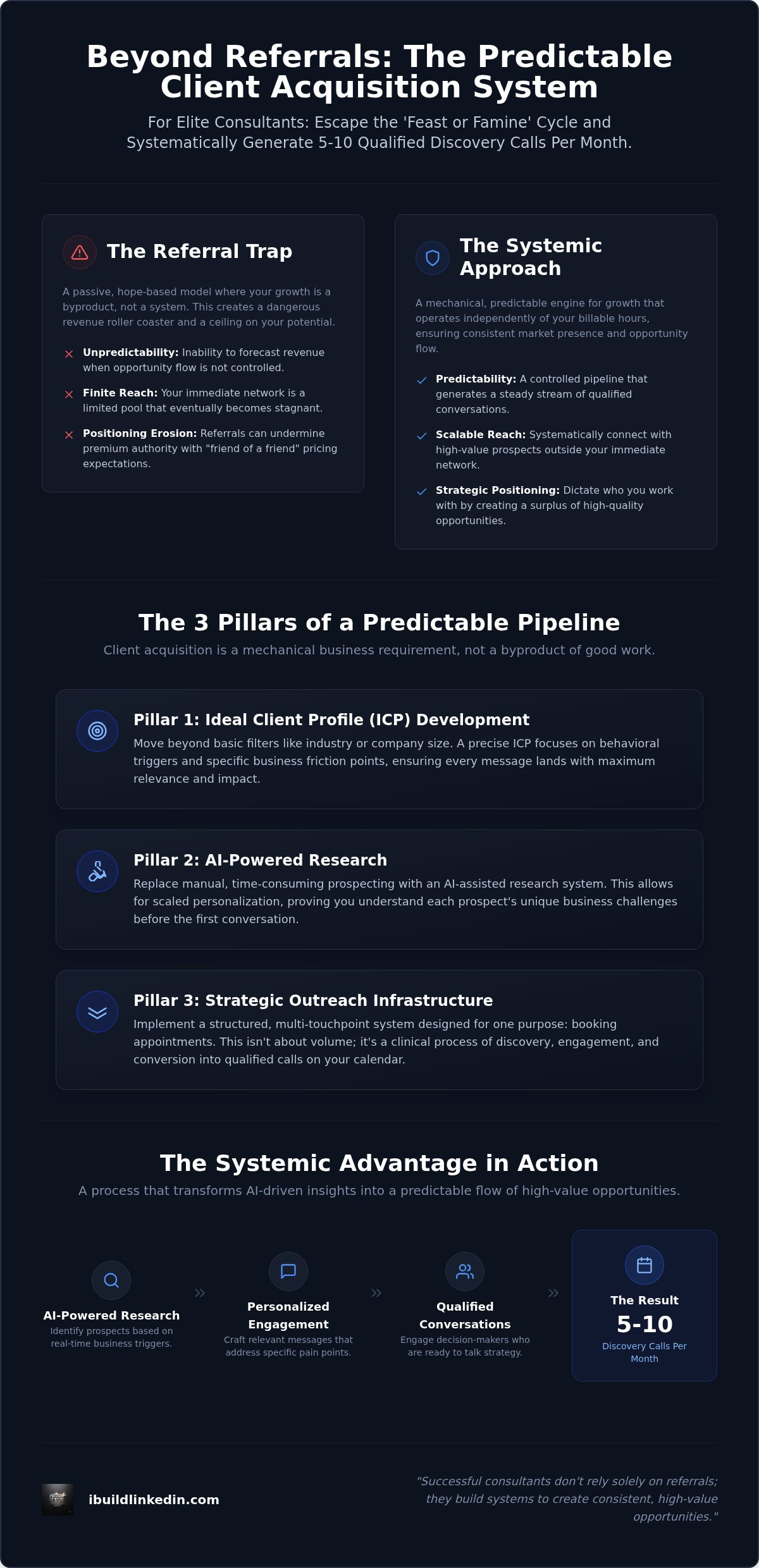
A business built entirely on referrals is a high-risk asset. You have zero control over the quality, timing, or project scope of incoming requests. You're forced to take what's offered rather than what you're strategically positioned to solve. This lack of control often leads to scope creep and price sensitivity because you don't have a backup option on your calendar. Referral Dependency is a structural business weakness where growth is dictated by external goodwill rather than internal systems. High-level predictable client acquisition ensures you're a maker of opportunities, not just a taker of whatever happens to cross your desk.
- Unpredictability: You can't forecast revenue when you don't control the flow of opportunities.
- Finite Reach: Your network is a limited pool that eventually dries up or becomes stagnant.
- Positioning Erosion: Referrals often come with "friend of a friend" expectations that can undermine your premium authority and pricing.
Breaking the 'Expertise Paradox'
Many consultants believe being "too busy" to prospect is a sign of success. It's actually the first sign of an impending financial crisis. This is the expertise paradox: the more you deliver, the less you develop. True market leaders aren't just experts; they're "In-Demand" experts who have more opportunities than they can handle. Shifting from a hope-based model to a system-based infrastructure is the only way to maintain your visibility while you're deep in client work. Installing a consistent pipeline for independent consultants is about building a durable infrastructure that operates independently of your billable hours. It's the difference between being a freelancer looking for a job and a strategist building a durable business.
The Mechanics of Predictable Client Acquisition in 2026
Building a consistent pipeline for independent consultants requires a hard shift in perspective. Most generic agencies treat acquisition as a brute-force numbers game. For a strategy consultant selling high-ticket engagements, volume is a distraction. You don't need a thousand clicks. You need five high-relevance conversations. Relevance is the only currency that matters in 2026. If your message doesn't land exactly where your prospect's pain point resides, it's just noise. You aren't looking for more people to talk to; you're looking for the right people to talk to at the right time.
Successful modern client acquisition strategies focus on three specific mechanics: Discovery, Engagement, and the Appointment. Discovery is about identifying the right person. Engagement is about proving you understand their specific business friction. The Appointment is the final objective. Stop measuring "impressions" or profile views. These are ego metrics that don't pay the bills. If your calendar isn't filling with qualified discovery calls, your system is failing. LinkedIn serves as the primary infrastructure for this because it's where decision-makers signal their professional priorities and challenges in real time.
The ICP Development Framework
Generic targeting is a waste of your time. Moving beyond basic filters like company size or industry is mandatory. You must look for behavioral triggers. Has the company recently lost a key executive? Are they navigating a specific regulatory change or market shift? These signals indicate a higher probability of needing external expertise. Your Ideal Client Profile (ICP) must identify who is currently experiencing the specific problem you solve. This strategic foundation ensures your outreach feels like a timely solution rather than a random intrusion. It's the difference between being a pest and being a partner.
Multi-Channel Synergy
Sending one message and hoping for a reply is an amateur move. High-value prospects require multiple touchpoints before they grant you access to their calendar. A 30-Day Touchpoint Map is non-negotiable for maintaining this rhythm. It creates a sequence of interactions that build authority without appearing desperate. You can implement a business development system that manages this complexity for you, ensuring no prospect falls through the cracks. By integrating personalized research with strategic follow-ups, you ensure your positioning matches the high-ticket nature of your services. Consistency is the bridge between being ignored and being invited to the table.
The 3 Pillars: ICP, AI Research, and Strategic Outreach Infrastructure
Consultants often fail at business development because they treat it as a creative chore rather than an engineering problem. To build a consistent pipeline for independent consultants, you must move past the idea that outreach is about luck. It's about infrastructure. A predictable system relies on three distinct pillars that work together to remove the friction of manual prospecting. When these pillars are installed correctly, the generic feel of traditional outreach disappears, replaced by a sophisticated, high-relevance interaction that decision-makers actually appreciate.
The first pillar is Hyper-Specific ICP Targeting. This isn't about broad industries. It's about finding the needle in the haystack by identifying the exact decision-makers facing the specific problems you solve. The second pillar, AI-Assisted Prospect Research, provides the intelligence needed to earn their attention. Finally, Systematic Outreach ensures that you execute a 30-Day Touchpoint Map with clinical precision. This isn't a one-off message. It's a structured sequence that builds authority and keeps you top-of-mind without requiring your constant manual intervention.
Leveraging AI for Deep Research
Modern acquisition relies on relevance, and relevance requires data. AI-assisted research allows you to identify recent news, hiring trends, or specific pain points within a target organization before you ever hit send. This intelligence ensures your first touchpoint is 100% relevant to their current business reality. Instead of guessing what a prospect cares about, you're responding to their actual professional environment. AI research replaces 10 hours of manual Googling per week, freeing you to focus on high-level strategy while the business development system handles the heavy lifting of information gathering.
Personalization at Scale
The market is exhausted by generic templates. There's a massive difference between a message that starts with "Hi [First Name]" and context-aware outreach that references a specific company challenge or goal. Scaling your volume shouldn't mean sacrificing your professional brand. A sophisticated outreach infrastructure allows you to maintain high-ticket positioning while reaching a wider audience. Follow-up sequences are managed systematically but designed to feel like a continuing human conversation. By focusing on qualified conversations rather than just "leads," you ensure that every interaction reinforces your status as a high-level expert. You aren't just sending messages; you're building a bridge between your expertise and their needs.
Why 'Thought Leadership' is Failing Your Pipeline
Content creation is often a sophisticated form of procrastination. You spend hours crafting the "perfect" post, hoping a decision-maker notices. They usually don't. While your network might "like" your insights, those likes don't fund a consistent pipeline for independent consultants. Thought leadership is a long-term positioning play, but it's a terrible short-term revenue strategy. If you're hiding behind a keyboard to avoid the perceived rejection of a direct conversation, your business will remain stagnant. You're trading actual growth for the comfort of being liked by people who will never buy from you.
The "Content Trap" is a revenue killer. It's the belief that if you just share enough value, the right clients will eventually find you. This is a passive hope, not a business strategy. In reality, most of your content is seen by peers, competitors, and low-level employees. The decision-makers you actually want to work with are busy running their companies. They aren't scrolling their feeds looking for a savior. They respond to direct, relevant, and well-researched outreach that addresses their specific business friction. Stop confusing visibility with viability.
Positioning vs. Prospecting
Strategic positioning makes the sale easier, but prospecting makes the sale happen. Your LinkedIn profile shouldn't be a digital resume or a gallery of your thoughts. It must function as a landing page that converts attention into interest. Many consultants resist this because they "don't want to be a salesperson." This is a fundamental misunderstanding of business development. You aren't selling; you're solving. If your expertise can fix a significant business problem, withholding that solution because you're afraid of being "salesy" is a disservice to your market. Your goal is to move from being an invisible expert to an accessible partner.
The Solution: Managed Outbound
You don't have to spend your billable hours doing manual research or sending messages. A managed business development system allows you to maintain your status as the "Expert" while the "Machine" handles the outreach mechanics. This creates immense psychological relief. Imagine waking up to booked appointments on your calendar without having spent a single minute digging through profiles or drafting follow-ups. Reframing outreach as a way to help people solve a documented problem removes the friction of "selling." You can implement a strategic outreach system that bridges the gap between your expertise and the clients who desperately need it. This infrastructure ensures a consistent pipeline for independent consultants that doesn't rely on the whims of an algorithm.
The Systemic Advantage: Implementing Your Done-For-You Machine
Strategy is cheap. Execution is where most independent consultants fail. You can spend weeks defining an Ideal Client Profile and drafting messages, but if you don't have a mechanism to send them, you have nothing. High-value consultants realize that their time is better spent on billable delivery than on the mechanical labor of prospect research. Independent consultants realistically bill for 120 to 160 days per year. Every hour you spend on manual outreach is an hour taken away from high-ticket client work. You don't just need a plan; you need a result. Implementing a consistent pipeline for independent consultants requires a professional-grade infrastructure that works while you're offline.
What a Managed System Looks Like
A Done-For-You Outreach System is the bridge between your strategic positioning and actual appointments on your calendar. It isn't a "set it and forget it" tool. It's a managed process. This includes end-to-end implementation: from hyper-specific ICP development to the final booking of a qualified conversation. By executing a 30-Day Touchpoint Map with clinical precision, the system ensures you stay top-of-mind without appearing desperate. You should expect your pipeline to transform within 30 days. Moving from a dry calendar to a predictable flow of 5 to 10 discovery calls monthly is a matter of engineering, not luck. Continuous campaign optimization ensures the system adapts to real-world market data, keeping your outreach sharp and relevant. You can explore Done-for-you LinkedIn outreach to see how this infrastructure fits into your current practice.
Taking the First Step
Most consultants are one bad month away from a financial dry spell. Take the Referral Dependency Test: if your network stopped providing referrals today, how long would your business survive? If the answer makes you uncomfortable, you're operating with a high-risk asset. Transitioning from manual, scattered effort to a systemic acquisition engine is the only way to secure your long-term growth. It's time to stop waiting for the phone to ring and start dictating your own revenue. You can book a strategy call to build your consistent pipeline and install the infrastructure your expertise deserves. Successful consultants don't rely solely on referrals; they build systems to create consistent opportunities.
Engineering Your Growth Infrastructure
Referrals are a byproduct of excellence, but they are not a business development strategy. Relying on them keeps you stuck on a revenue roller coaster that limits your scale and increases your financial anxiety. To break this cycle, you must move from passive hope to active engineering. Building a consistent pipeline for independent consultants requires a shift toward structured systems that operate independently of your delivery schedule. You've already seen how the three pillars of ICP targeting, AI-powered prospect research, and systematic outreach can remove the friction of manual prospecting.
The transition from an invisible expert to an in-demand strategist happens when you stop doing everything yourself. By leveraging managed appointment booking and a proven 30-Day Touchpoint Map, you ensure that your business development remains active even when you are deep in client delivery. It's time to stop waiting for the phone to ring and start dictating your own revenue growth. You have the expertise; now you need the engine. Build your predictable consulting pipeline with iBuildLinkedIn and take control of your market presence today.
Frequently Asked Questions
How do consultants get clients consistently without referrals?
Consultants achieve consistency by installing a predictable client acquisition system that operates outside their immediate network. You must transition from reactive networking to proactive, relevance-based outreach. This involves using behavioral triggers to identify prospects who are currently experiencing the specific business friction you solve, ensuring you aren't waiting for the phone to ring.
What is a consulting pipeline and why do I need one?
A consulting pipeline is the mechanical infrastructure that moves a prospect from initial discovery to a qualified conversation. You need one to eliminate the "feast or famine" revenue roller coaster. A structured pipeline provides visibility into your future revenue, allowing you to focus on client delivery without the anxiety of wondering where the next project will come from.
How much time should an independent consultant spend on business development?
You should spend as little time as possible on the manual mechanics of prospecting. High-value consultants focus on delivery and strategy, not manual research. By installing a business development system, you can maintain your billable hours while a managed outreach infrastructure handles the research and outreach required to fill your calendar.
Is LinkedIn outreach still effective for high-ticket consultants in 2026?
LinkedIn remains the primary infrastructure for B2B growth, but only if you move past generic messaging. Success in 2026 requires a multi-touch approach, such as a 30-Day Touchpoint Map. This sequence uses context-aware research to prove you understand a prospect's specific challenges, which is the only way to earn the attention of busy executive decision-makers.
What is the difference between a lead and a qualified conversation?
A lead is just a data point; a qualified conversation is a scheduled interaction with a decision-maker who has a confirmed pain point. Measuring leads is a vanity exercise that doesn't track revenue potential. You should focus exclusively on qualified conversations, as these are the only interactions that lead to high-ticket consulting engagements and durable business growth.
Can I scale my consulting outreach without looking like a spammer?
Relevance is the antidote to noise. You can scale your outreach by using AI-assisted research to ensure every touchpoint reflects the prospect's actual professional environment. When your message addresses a recent hiring trend or a documented market shift, it feels like a timely solution rather than a random intrusion, protecting your professional brand while increasing your volume.
How many discovery calls do I need to book every month for steady growth?
Most established consultants require 5 to 10 discovery calls monthly to maintain a consistent pipeline for independent consultants. This volume allows you to be selective with your projects and maintain premium pricing. It provides enough fresh opportunities to replace completed contracts without overwhelming your capacity to deliver results for your current clients.
Why should I choose a done-for-you acquisition system over a coach?
Coaching offers advice, but systems offer infrastructure. Most consultants don't need more "how-to" homework; they need the execution handled for them. A done-for-you outreach system provides the end-to-end implementation of your acquisition strategy, bridging the gap between your internal expertise and your external market presence without requiring your manual labor.

Article by
Botirjon Ergashev
Botir Ergashev is the founder of iBuildLinkedIn, an AI-powered client acquisition systems company helping consultants build predictable growth beyond referrals.
He specializes in creating structured client acquisition systems that combine strategic positioning, ideal client research, personalised outreach, and AI-assisted processes to help consultants connect with qualified decision-makers.
Through iBuildLinkedIn, Botir helps consultants replace inconsistent referral-based growth with a repeatable system designed to generate meaningful business conversations and consulting opportunities.
His focus is helping experienced consultants build scalable growth infrastructure while staying focused on delivering exceptional client results.
Important Notice
The information shared in these articles is for educational and informational purposes only. Results from client acquisition systems, outreach strategies, and business development efforts vary depending on factors such as market, offer quality, positioning, sales process, and execution.
iBuildLinkedIn provides strategic systems and implementation support designed to help consultants build more predictable client acquisition processes. We do not guarantee specific revenue outcomes, clients, or business results.
